

Galaxy S20's 120Hz refresh rate is awesome despite the limitations
Samsung's move to displays with high refresh rates has come up afterwards than most other players in the Android smartphone market place. Just the Korean giant fabricated upward for the delay by going directly to 120Hz refresh rate instead of slapping a 90Hz brandish on its latest flagship, the Galaxy S20 series. The Milky way S20, S20+ and S20 Ultra are the world'due south first smartphones to feature 120Hz OLED displays, and after just a short time of using the S20+, I've realized that adjusting to annihilation less than 120Hz refresh charge per unit is going to exist extremely tough to do.
Refresh charge per unit, according to its definition on Google, is "the frequency with which the image on a reckoner monitor or like electronic display screen is refreshed, unremarkably expressed in hertz." A 60Hz brandish refreshes the image on-screen 60 times every second, a 120Hz screen refreshes the epitome 120 times, and then on. What that means in layman terms is that every kind of moving content, such as a moving-picture show, game, or a GIF, is a result of a bunch of static images existence displayed on-screen in quick succession to simulate move, and the faster the refresh charge per unit, the faster and smoother everything from movies and games to uncomplicated animations and scrolling will seem.
Limitations bated, loftier refresh charge per unit displays make a large departure
And, on the Milky way S20, the smoother user interface animations and scrolling make all the difference in the globe. Samsung'southward Ane UI peel is cute, and it feels even more so on my Milky way S20+. On the Galaxy S10+ and Note ten+, the animations for when you lot whorl through an app or when you open an app look positively laggy in comparison. It's not that the S10+ and Note 10+ are actually laggy, just the fact that their displays can't refresh as rapidly as the display on the S20+ makes it seemlike the animations stutter on the 2019 flagships.
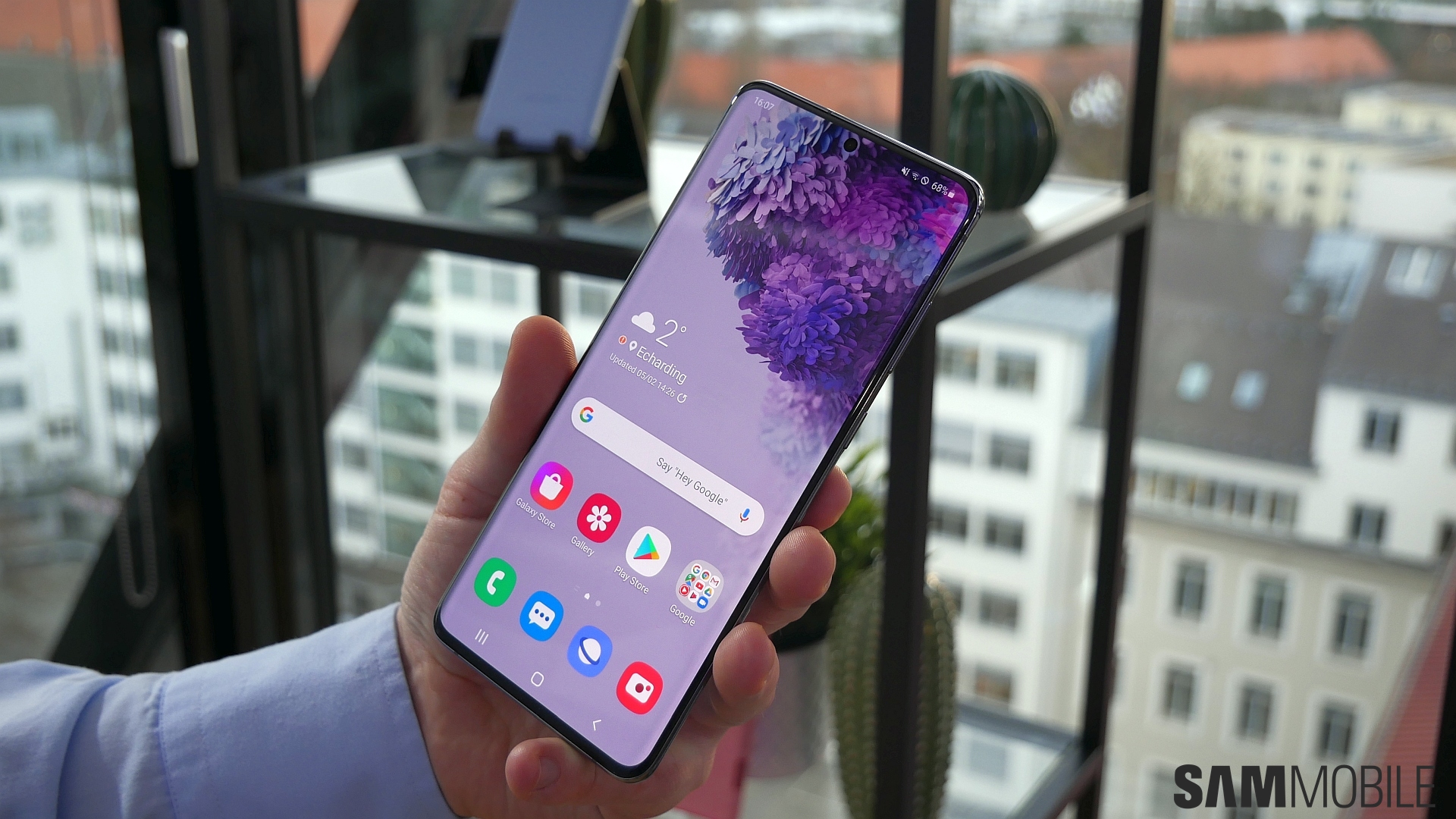
Once more, it's comparative: If y'all've not used a smartphone display with a loftier refresh charge per unit before, you won't find anything wrong with your Galaxy S10, Notation ten, or any other Milky way smartphone in mean solar day-to-solar day use. Only once you've had the pleasure of using one of the Milky way S20 smartphones for a few hours, you will instantly start noticing how your existing smartphone — whether it's a flagship, mid-range, or budget device — doesn't seem to exist equally fast every bit you thought it was before y'all picked upwardly a Galaxy S20.
In fact, it'southward making me dread having to use other Galaxy smartphones with 60Hz displays to review them in the coming months – the 120 Hz display on the Galaxy S20 is that good. Many wonder what all the excitement for high refresh rate displays is all about – I was i of them until I started using the Galaxy S20+, and I'm now a full laic. I really hope high refresh rate displays will get more commonplace across Milky way devices of all segments despite some of their limitations.
What limitations are those? Well, starting time of all, the loftier refresh rate results in noticeable reduction in battery life. Secondly, the 120 Hz screen fashion doesn't stay agile all the fourth dimension. Equally nosotros had reported when the Galaxy S20 went official, the telephone reverts to 60 Hz refresh rate when the device temperature goes above 42C, when apps like Photographic camera and Google Maps are being used, and when battery life goes below 5%. And, the problem is, the Galaxy S20+ does tend to easily heat up, specially if you lot take a lot of photos and if you record 8K videos.
And information technology doesn't seem like the phone waits to reach 5% accuse, either. I noticed the refresh rate going low even at fifteen% bombardment life, so there are plenty of situations where the phone doesn't allow you savour the 120Hz refresh charge per unit. Yes, you too can't use 120Hz with the maximum screen resolution. I don't exactly see a trouble with that, but if you practice, there's promise Samsung will remove the resolution limitation with a software update in the future or at least on its next 2020 flagship.
We'll have more to tell you virtually the high refresh rate displays on the Galaxy S20, S20+ and S20 Ultra in our upcoming reviews, but if yous need a single word answer to whether or not the 120Hz screen on Samsung's new flagship series is a solid reason to make the buy, our response is a resounding yes.

Source: https://www.sammobile.com/opinions/galaxy-s20-120hz-refresh-rate-is-awesome-despite-the-limitations/
Posted by: boveefouldlairity.blogspot.com
0 Response to "Galaxy S20's 120Hz refresh rate is awesome despite the limitations"
Post a Comment